Understanding TDS: What's Safe for Drinking?
💧 What Exactly is TDS?
Whenever we talk about water purifiers or water quality, the word TDS comes up constantly. But what does it mean?
TDS stands for Total Dissolved Solids.
It represents the total amount of inorganic salts (like calcium, magnesium, potassium, sodium, bicarbonates, chlorides, and sulfates) and small amounts of organic matter dissolved in water.
🔬 Think of it this way: If you evaporate a liter of water completely, the powdery residue left behind is the TDS. It is measured in mg/L or ppm (Parts Per Million).
📊 The TDS Scorecard: What is Safe and What is Not?
Not all dissolved solids are bad. Your body actually needs minerals like calcium and magnesium. However, too much or too little TDS can both be problematic.
Here is the official Bureau of Indian Standards (BIS) and WHO-aligned breakdown of TDS levels:
| TDS Level (ppm) | Quality Rating | What Does It Mean for You? |
| Less than 50 | ❌ Too Low / Poor | Water is devoid of essential minerals. It tastes flat, acidic, and can leach minerals from your body over time. |
| 50 – 150 | 👍 Acceptable | Generally safe, often found in mountain springs or heavy RO-filtered water. Good, but missing some mineral depth. |
| 150 – 300 | 🌟 Excellent | The Sweet Spot! Ideal for drinking. It retains healthy essential minerals while keeping harmful contaminants out. |
| 300 – 500 | 👌 Good | Perfectly safe to drink. The taste is balanced, and it poses no health risks. |
| 500 – 900 | ⚠️ Fair / Palatable | Safe to drink according to official limits, but the water might taste heavy, hard, or slightly salty. |
| Above 1200 | 🚫 Unacceptable | Highly toxic and unsafe. Contains dangerously high mineral/chemical levels. Completely unfit for consumption. |
🚨 Why Does Extreme TDS Matter?
1. If TDS is Too High (Above 500-900 ppm)
Health Risks: High TDS often indicates the presence of harmful heavy metals like lead, arsenic, or nitrates, which can cause kidney stones and long-term health issues.
Household Damage: It causes scaling in your kitchen appliances, pipes, and leaves white stains on utensils.
Bad Taste: Water tastes bitter, salty, or metallic.
Health Risks: High TDS often indicates the presence of harmful heavy metals like lead, arsenic, or nitrates, which can cause kidney stones and long-term health issues.
Household Damage: It causes scaling in your kitchen appliances, pipes, and leaves white stains on utensils.
Bad Taste: Water tastes bitter, salty, or metallic.
2. If TDS is Too Low (Below 50 ppm)
Mineral Deficiency: Stripping water completely of TDS removes calcium and magnesium, which are vital for bone and heart health.
The "RO Trap": Many aggressively tuned RO systems bring TDS down to 20 or 30 ppm. While it is pure, it isn't healthy for long-term use.
Mineral Deficiency: Stripping water completely of TDS removes calcium and magnesium, which are vital for bone and heart health.
The "RO Trap": Many aggressively tuned RO systems bring TDS down to 20 or 30 ppm. While it is pure, it isn't healthy for long-term use.
🛠️ How to Manage TDS: Choosing the Right Purifier
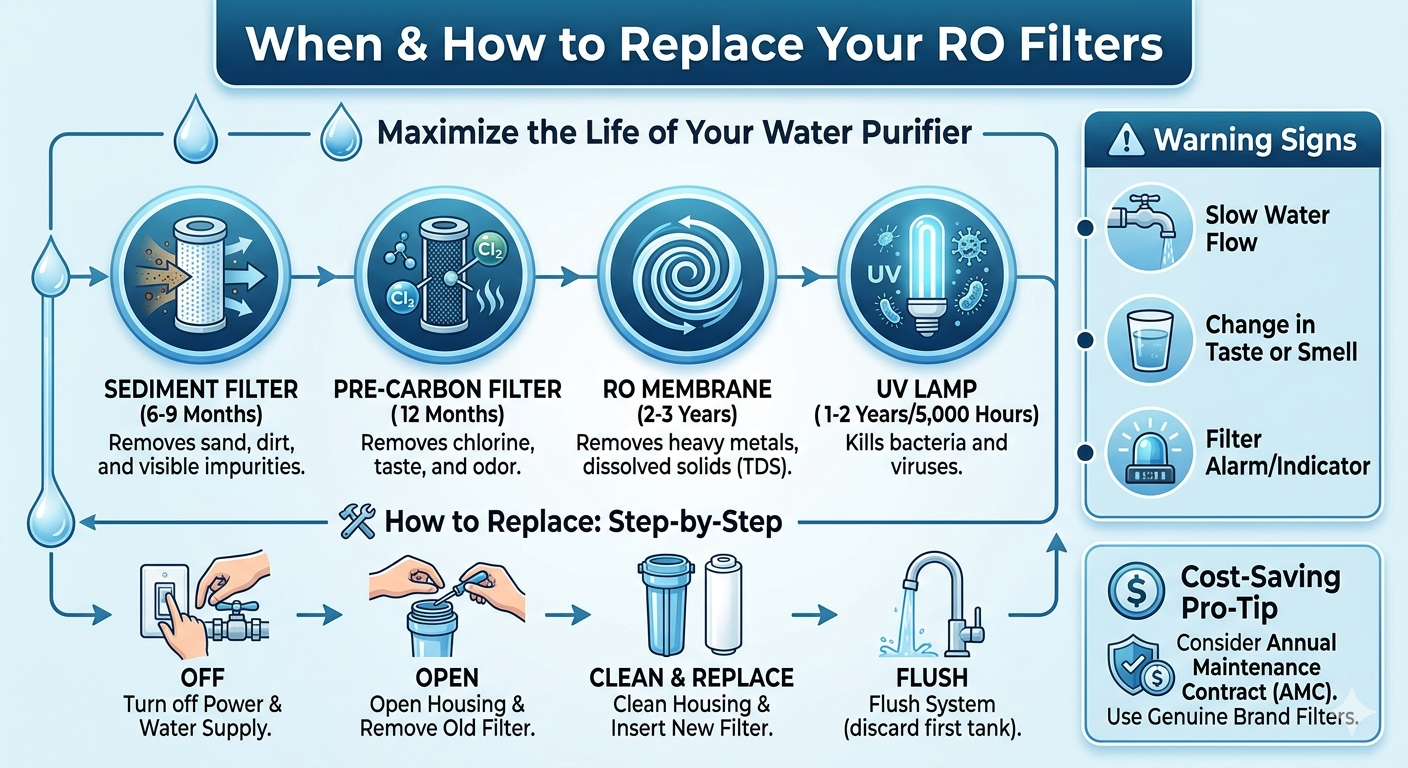
You shouldn't buy a water purifier blindly. First, buy a cheap TDS Meter online and test your tap water. Based on your reading, pick your technology:
If your input TDS is under 200-300 ppm: You do NOT need an RO purifier. A standard UV + UF purifier is enough to kill bacteria and filter dust while preserving natural minerals.
If your input TDS is above 500 ppm: An RO (Reverse Osmosis) purifier is mandatory to bring down the heavy hardness.
The Best Solution: Look for an RO system that comes with a TDS Controller (Modulator) or a Mineral Cartridge (MTDS). This technology allows the purifier to strip the bad solids but add back healthy minerals so your final drinking water stays right in the 150–300 ppm sweet spot.
Are you planning to check your home's TDS level, or are you currently trying to figure out if your existing RO water tastes a bit too flat?
💧 What Exactly is TDS?
Whenever we talk about water purifiers or water quality, the word TDS comes up constantly. But what does it mean?
TDS stands for Total Dissolved Solids.
It represents the total amount of inorganic salts (like calcium, magnesium, potassium, sodium, bicarbonates, chlorides, and sulfates) and small amounts of organic matter dissolved in water.
🔬 Think of it this way: If you evaporate a liter of water completely, the powdery residue left behind is the TDS. It is measured in mg/L or ppm (Parts Per Million).
📊 The TDS Scorecard: What is Safe and What is Not?
Not all dissolved solids are bad. Your body actually needs minerals like calcium and magnesium. However, too much or too little TDS can both be problematic.
Here is the official Bureau of Indian Standards (BIS) and WHO-aligned breakdown of TDS levels:
| TDS Level (ppm) | Quality Rating | What Does It Mean for You? |
| Less than 50 | ❌ Too Low / Poor | Water is devoid of essential minerals. It tastes flat, acidic, and can leach minerals from your body over time. |
| 50 – 150 | 👍 Acceptable | Generally safe, often found in mountain springs or heavy RO-filtered water. Good, but missing some mineral depth. |
| 150 – 300 | 🌟 Excellent | The Sweet Spot! Ideal for drinking. It retains healthy essential minerals while keeping harmful contaminants out. |
| 300 – 500 | 👌 Good | Perfectly safe to drink. The taste is balanced, and it poses no health risks. |
| 500 – 900 | ⚠️ Fair / Palatable | Safe to drink according to official limits, but the water might taste heavy, hard, or slightly salty. |
| Above 1200 | 🚫 Unacceptable | Highly toxic and unsafe. Contains dangerously high mineral/chemical levels. Completely unfit for consumption. |
🚨 Why Does Extreme TDS Matter?
1. If TDS is Too High (Above 500-900 ppm)
Health Risks: High TDS often indicates the presence of harmful heavy metals like lead, arsenic, or nitrates, which can cause kidney stones and long-term health issues.
Household Damage: It causes scaling in your kitchen appliances, pipes, and leaves white stains on utensils.
Bad Taste: Water tastes bitter, salty, or metallic.
Health Risks: High TDS often indicates the presence of harmful heavy metals like lead, arsenic, or nitrates, which can cause kidney stones and long-term health issues.
Household Damage: It causes scaling in your kitchen appliances, pipes, and leaves white stains on utensils.
Bad Taste: Water tastes bitter, salty, or metallic.
2. If TDS is Too Low (Below 50 ppm)
Mineral Deficiency: Stripping water completely of TDS removes calcium and magnesium, which are vital for bone and heart health.
The "RO Trap": Many aggressively tuned RO systems bring TDS down to 20 or 30 ppm. While it is pure, it isn't healthy for long-term use.
Mineral Deficiency: Stripping water completely of TDS removes calcium and magnesium, which are vital for bone and heart health.
The "RO Trap": Many aggressively tuned RO systems bring TDS down to 20 or 30 ppm. While it is pure, it isn't healthy for long-term use.
🛠️ How to Manage TDS: Choosing the Right Purifier
You shouldn't buy a water purifier blindly. First, buy a cheap TDS Meter online and test your tap water. Based on your reading, pick your technology:
If your input TDS is under 200-300 ppm: You do NOT need an RO purifier. A standard UV + UF purifier is enough to kill bacteria and filter dust while preserving natural minerals.
If your input TDS is above 500 ppm: An RO (Reverse Osmosis) purifier is mandatory to bring down the heavy hardness.
The Best Solution: Look for an RO system that comes with a TDS Controller (Modulator) or a Mineral Cartridge (MTDS). This technology allows the purifier to strip the bad solids but add back healthy minerals so your final drinking water stays right in the 150–300 ppm sweet spot.
Are you planning to check your home's TDS level, or are you currently trying to figure out if your existing RO water tastes a bit too flat?
Found this helpful?
Check out our comparison tool to find the perfect purifier matching the criteria discussed in this article.
Explore All Purifiers