How to Choose the Right Water Purifier in 2026
How to Choose the Right Water Purifier in 2026: Complete Buying Guide for India
Choosing the right water purifier in 2026 depends on three things: your water's TDS level, your family size, and your budget. Whether you live in a Delhi flat with chlorine-heavy municipal water, a Bangalore apartment where TDS can swing from 68 to 1,236 ppm in just four months, or a Jaipur home running on hard borewell water, the right RO, UV, or UF purifier choice can save you thousands of rupees and protect your family's long-term health.
This buying guide walks you through every step — testing your water, comparing technologies, picking the right capacity, and choosing between the top water purifier brands in India for 2026, including Kent, Aquaguard, AO Smith, Pureit, Atomberg, Livpure, and Havells. By the end, you'll know exactly which model is right for your home and roughly what you'll spend over the next 5 years.
Why Water Purifier Choice Matters in 2026
India's water crisis is real and measurable. The Bureau of Indian Standards (BIS IS 10500:2012) sets the acceptable Total Dissolved Solids (TDS) limit for drinking water at 500 mg/L, but municipal supplies across many Indian cities regularly exceed this threshold. A DrinkPrime water quality study in Bengaluru's Electronic City recorded TDS jumping from 68 ppm to 1,236 ppm in just four months — a clear sign that even "good" municipal supplies can degrade fast.
More worrying: TDS meters cannot detect heavy metals like lead, arsenic, or fluoride. The Indian Council of Medical Research (ICMR) recommends drinking water TDS between 100–500 mg/L, while the World Health Organization (WHO) considers anything above 1,000 mg/L unacceptable. A wrong purifier choice means paying for unnecessary technology, wasting water, or worse — drinking contaminated water.
FACT: The National Green Tribunal (NGT) has recommended restricting RO purifiers in areas with TDS below 500 mg/L because over-purification removes essential minerals and wastes up to 80% of input water.
Step 1: Check Your Water Source & TDS Level
Before comparing any water purifier, test your water's TDS — the amount of dissolved minerals, salts, and metals. TDS is the single most important factor in choosing between RO, UV, and UF.

Figure 1: Recommended water purifier by TDS level (per BIS IS 10500:2012)
Recommended Purifier by TDS Level
TDS (ppm)
Water Quality
Recommended Purifier
Typical Price
Below 150
Excellent (low minerals)
UV or UF only
Rs.6,000 – Rs.10,000
150 – 300
Good (BIS ideal)
UV + UF
Rs.8,000 – Rs.13,000
300 – 500
Fair (BIS limit)
RO + UV + UF + Mineralizer
Rs.12,000 – Rs.20,000
500 – 900
Poor (hard water)
RO + UV + UF + TDS Controller
Rs.15,000 – Rs.25,000
Above 900
Very poor / unsafe
Heavy-duty RO + UV + UF + Mineralizer
Rs.20,000 – Rs.35,000
How to Test Your Water TDS
You can measure your water's TDS in three ways:
Buy a digital TDS meter online for Rs.300–Rs.500 — quickest and most reusable.
Request a free TDS test from any major brand (Kent, Aquaguard, Pureit) when they come for a demo.
Get a complete lab test (Rs.500–Rs.1,500) for a full chemical and microbial report — recommended if you suspect borewell contamination.
CRITICAL: A TDS meter only measures dissolved solids — it cannot detect heavy metals like lead, arsenic, or fluoride. If you're on borewell water or in a known contamination zone (parts of Rajasthan, West Bengal, and Punjab), do a full lab test before deciding.
Step 2: Understand RO vs UV vs UF Technology
Indian water purifiers in 2026 use one or a combination of three core technologies. Understanding the difference saves you from overpaying for features you don't need or under-buying for the water you actually have.

Figure 2: RO vs UV vs UF — what each technology removes
RO (Reverse Osmosis)
RO forces water through a semi-permeable membrane (0.0001 micron pore size) to remove dissolved salts, heavy metals, pesticides, arsenic, and fluoride. RO is essential whenever your TDS is above 300 ppm. Modern 2026 RO purifiers recover 50–75% of input water, a huge improvement over the 25% recovery of older models.
Best for: Borewell water, hard water, tanker water, high-TDS municipal supply
Trade-off: Removes essential minerals (always pair with a mineralizer or TDS controller)
UV (Ultraviolet)
UV purifiers shine ultraviolet light through water to kill bacteria, viruses, cysts, and other microorganisms. They don't remove TDS or heavy metals.
Best for: Municipal-treated water with TDS below 200 ppm
Trade-off: Useless against dissolved chemicals; needs electricity
UF (Ultrafiltration)
UF uses hollow-fiber membranes (0.01 micron) to physically block bacteria, cysts, mud, and sediment. It works without electricity, making it useful in power-cut prone areas.
Best for: Power-backup setups, supplementing UV+RO systems
Trade-off: Cannot kill viruses or reduce TDS
RO + UV + UF Combination (Most Recommended for India)
For most Indian homes with variable water quality, the RO + UV + UF combination — usually with a mineralizer or alkaline cartridge — offers complete protection. Look for the new BIS IS 16240:2023 certification on water purifiers in 2026; it confirms the unit meets India's latest safety and performance standards.
Copper, Alkaline & Mineral RO: Are They Worth It?
2026's premium purifiers add health-boosting layers on top of RO:
Copper RO: Infuses copper ions into water, mimicking traditional Indian copper-vessel storage. Costs Rs.3,000–Rs.5,000 more.
Alkaline RO: Raises water pH to 8–9.5, claimed to improve hydration and acid balance.
Mineralizer / TDS controller: Adds back essential calcium, magnesium, and potassium removed during RO. Highly recommended — not optional.
Step 3: Pick the Right Storage Capacity
Storage capacity decides how much purified water is available during power cuts or peak demand. Indian homes typically consume 2–3 litres of drinking water per person per day, plus extra for cooking.
Family Size
Recommended Tank
Real-World Tip
1 – 2 members
5 – 7 litres
Wall-mounted models save space
3 – 4 members
7 – 9 litres
Most popular range for Indian homes
5 – 6 members
10 – 12 litres
Steel tank lasts longer in hard water
Large family / Office
12+ litres or under-counter
Look at AO Smith, Aquaguard XL
Step 4: Smart Features Worth Paying For in 2026
Not every smart feature deserves the extra cost. Here's what actually saves you money and headache over 5 years:
Filter-change indicator (must-have) — saves you Rs.500–Rs.1,500 on unnecessary AMC visits.
Real-time TDS display (must-have) — lets you confirm water quality at a glance.
Auto-flush technology (must-have) — extends RO membrane life from 2 to 3+ years, a Rs.1,500–Rs.3,000 saving.
Adjustable TDS via app (nice-to-have) — Atomberg Intellon and a few 2026 models let you tune output TDS for taste.
App connectivity (Wi-Fi/Bluetooth) (skip if you don't use apps) — useful for filter reminders and remote diagnostics.
Hot & cold dispensing (luxury) — adds Rs.10,000+ to the price; only worth it if you replace your kettle and water cooler.
Voice control (Alexa/Google) (skip) — gimmicky for water purifiers. Save the money.
Step 5: Compare Brands & After-Sales Service
In a country where service quality varies dramatically by city, the brand you choose matters as much as the technology. Here are the trusted water purifier brands in India for 2026:

Figure 3: Trusted water purifier brands in India 2026
When comparing brands, focus on these four factors:
Service network in your specific city (Kent and Aquaguard have the widest pan-India coverage).
AMC pricing transparency — some brands charge Rs.1,500/year, others Rs.5,800/year. Confirm in writing before buying.
Warranty terms — 2-year unconditional warranties (covering filters and electrical parts) are now standard from Pureit, Livpure, and Kenstar.
Filter availability — check if spare filters are sold online and at local service centres.
Top 5 Water Purifiers in India 2026 (Compared)
Based on TDS handling, build quality, AMC cost, service network, and user reviews across BharatCompare's product database, these are the five best water purifiers in India for 2026:

Figure 4: Top 5 water purifiers in India for 2026, by category
Detailed Specs Comparison
Model
Best For
Technology
Tank
Price
Kent Grand Star
Best overall
RO+UV+UF+TDS+Alkaline+Copper
9 L
Rs.17k–22k
HUL Pureit Eco Water Saver
Best value, low wastage
RO+UV+Mineralizer+Eco Recovery
10 L
Rs.13k–16k
Atomberg Intellon
Best smart
RO+UV with adjustable TDS via app
7 L
Rs.15k–18k
AO Smith Z9 Pro
Best premium
8-Stage RO+UV+Mineralizer+Hot/Cold
10 L
Rs.25k–32k
Aquaguard Delight NXT
Best budget
RO+UV+UF+Active Copper
7 L
Rs.8k–11k
Honourable mentions: Livpure Allura Premia (mid-range), V-Guard Rejive 2X (steel tank), Havells Aquas Neo (budget RO+UF), and Urban Company Native M2 Pro (subscription-based, smart IoT).
Water Purifier Price Range in India 2026

Figure 5: Water purifier price segments in India 2026
Here's what your budget actually buys in 2026:
Segment
Price Range
Features
Entry-level
Rs.6,000 – Rs.10,000
Basic UV or UF, small 5–7 L tank, manual filter alerts
Budget
Rs.10,000 – Rs.15,000
RO+UV, 7–8 L tank, basic mineralizer
Mid-range (BEST VALUE)
Rs.15,000 – Rs.25,000
RO+UV+UF, mineralizer, auto-flush, copper/alkaline option
Premium
Rs.25,000 – Rs.40,000
App-enabled, hot & cold, 10 L+ steel tank, premium build
Luxury
Rs.40,000+
AI-tuned filtration, voice control, multi-stage premium
For most Indian families (TDS 200–600 ppm, 4 members), the Rs.15,000–Rs.22,000 mid-range bracket offers the best price-to-performance ratio.
5-Year Total Cost of Ownership Breakdown
Most buyers focus only on the sticker price. The real cost over 5 years is 2–3 times higher. Here's the breakdown for a typical mid-range RO+UV+UF purifier:
Cost Component
Annual
5-Year Total
Initial purchase (mid-range model)
— (one-time)
Rs.18,000
Filter replacements (sediment + carbon)
Rs.1,500 – Rs.2,500
Rs.10,000
RO membrane (every 2–3 years)
Rs.700 – Rs.1,200
Rs.4,500
UV lamp (yearly)
Rs.800 – Rs.1,200
Rs.5,000
Service / AMC visits
Rs.1,500 – Rs.4,500
Rs.12,000
Electricity
Rs.1,200 – Rs.3,000
Rs.10,000
TOTAL 5-YEAR OWNERSHIP
—
Rs.59,500
BharatCompare tip: A Rs.18,000 purifier really costs about Rs.60,000 over 5 years. Compare AMC costs across brands — Kent's premium AMC can run Rs.5,800/year, while Atomberg's is Rs.0 with pay-per-filter pricing.
Top Mistakes to Avoid When Buying a Water Purifier
Buying RO without testing TDS — RO removes essential minerals and wastes water if your TDS is already below 300 ppm.
Relying on TDS alone — a low TDS reading doesn't mean the water is free of heavy metals, fluoride, or pesticides.
Skipping the mineralizer — pure RO water is mineral-deficient. Always include a TDS controller or alkaline cartridge.
Ignoring AMC costs — some brands charge Rs.5,000+ per year, which doubles your 5-year cost.
Falling for marketing terms — "10-stage purification" usually means 4 real stages plus 6 cosmetic ones.
Wrong tank size — too small means constant waiting during power cuts; too large means stale water.
Buying from unknown brands without local service — even premium specs are useless without service support.
Frequently Asked Questions (FAQ)
Which water purifier is best for Indian homes in 2026?
For TDS 300–900 ppm (most Indian homes), an RO+UV+UF purifier with a mineralizer is best. Top picks include Kent Grand Star, HUL Pureit Eco Water Saver, and AO Smith Z9 Pro. For low TDS (<200 ppm) municipal water, a UV+UF purifier is sufficient and avoids water wastage.
What is the ideal TDS level for drinking water in India?
Per BIS IS 10500:2012, TDS below 500 mg/L is acceptable for drinking water. WHO recommends below 300 mg/L for optimal taste. The ideal range for both health and palatability is 150–300 mg/L. Water below 50 mg/L is too demineralised for daily consumption.
Is RO water bad for health?
Pure RO water without a mineralizer can be unhealthy long-term because it removes calcium, magnesium, and potassium. Always buy an RO purifier with a built-in TDS controller, mineral cartridge, or alkaline stage to restore essential minerals.
Do I need RO if I get municipal water?
Not always. Municipal water in metros like Delhi, Mumbai, and Bangalore typically has TDS between 150–400 ppm. If your TDS is below 300 ppm and your supply is treated, a UV+UF purifier is sufficient and avoids the 25–50% water wastage of RO.
How often should water purifier filters be replaced?
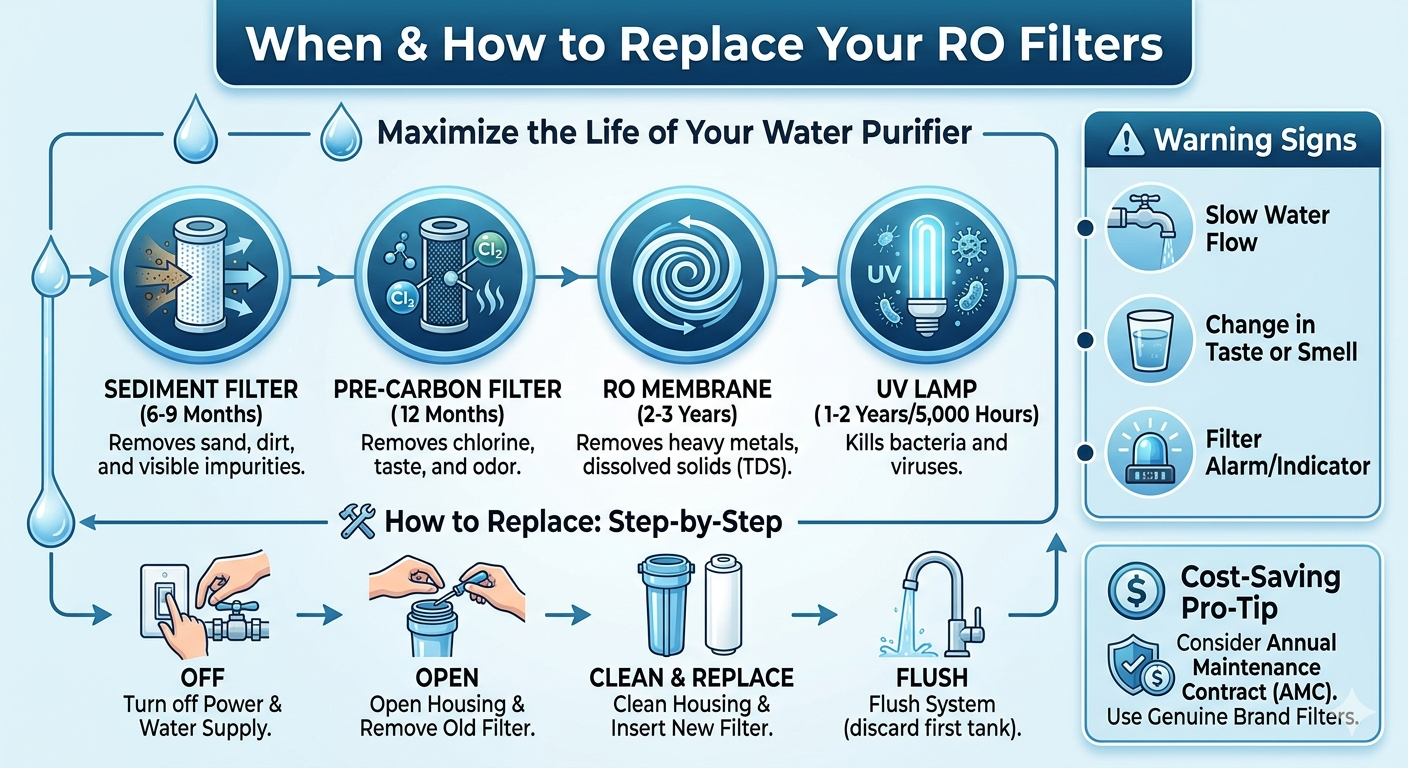
Sediment and carbon pre-filters: every 6–12 months. RO membrane: every 2–3 years. UV lamp: every 12 months. Most 2026 purifiers have automatic indicators for replacement.
What is the difference between RO, UV, and UF water purifiers?
RO uses a 0.0001 micron membrane to remove dissolved salts and heavy metals (best for high TDS). UV uses ultraviolet light to kill bacteria and viruses (best for microbial contamination). UF uses 0.01 micron membranes to filter cysts and sediment (works without electricity).
How much electricity does a water purifier use?
A typical RO purifier draws 25–60 watts during purification cycles. Monthly electricity cost is Rs.100–Rs.250 depending on usage. UV-only purifiers consume even less.
Is a copper water purifier worth the extra cost?
Copper RO adds copper ions to water, replicating traditional copper-vessel storage. Research suggests copper has mild antimicrobial benefits. The Rs.3,000–Rs.5,000 premium is justified if you drink purified water daily and value the wellness angle.
What is the BIS IS 16240:2023 certification?
IS 16240:2023 is the updated Bureau of Indian Standards specification for household water purifiers, covering performance, safety, and labelling requirements. Look for this certification on packaging in 2026 — it confirms the unit meets India's latest quality benchmarks.
Can I install a water purifier myself?
Most purifiers require professional installation because of plumbing and electrical connections. All major brands (Kent, Aquaguard, Pureit, AO Smith) offer free installation within 24–48 hours of purchase.
What is the lifespan of a water purifier?
With timely filter replacements and regular service, a quality water purifier lasts 8–10 years. The body and tank usually outlive the membrane (replaced every 2–3 years) and electronics.
Is bottled water safer than RO purifier water?
A well-maintained RO+UV+UF purifier produces water at least as safe as packaged bottled water — and at a fraction of the cost. A family of four spends Rs.30,000+ annually on bottled water, versus Rs.10,000 in filter and AMC costs for a purifier.
Which is the best water purifier under Rs.15,000 in India 2026?
Under Rs.15,000, the HUL Pureit Eco Water Saver (Rs.13,000–Rs.16,000) and Aquaguard Delight NXT (Rs.8,000–Rs.11,000) are the best picks. Both offer multi-stage RO+UV purification with reliable service support.
Do water purifiers waste a lot of water?
Older RO purifiers wasted 3 litres for every 1 litre purified. Modern 2026 models recover 50–75% of input water. Pureit's Eco Water Saver and Aquaguard's water-saving variants are designed specifically for water-scarce areas.
What is the best water purifier brand in India?
Kent leads in market share and service network, followed by Aquaguard (Eureka Forbes) and HUL Pureit. AO Smith leads premium quality, while Atomberg leads smart features. Choose based on local service availability in your city.
Final Verdict: Which Water Purifier Should You Buy?
Use this simple decision matrix based on your specific situation:
Low TDS (<200 ppm), municipal water, small family: UV + UF purifier — try Aquaguard Crystal NXT or Pureit Classic UV (Rs.6,000–Rs.10,000).
Medium TDS (200–500 ppm), 3–4 members: RO + UV + UF with mineralizer — HUL Pureit Eco Water Saver or Aquaguard Delight NXT (Rs.12,000–Rs.16,000).
High TDS (500+ ppm), borewell or hard water: Heavy-duty RO + UV + UF with TDS controller — Kent Grand Star or AO Smith Z9 Pro (Rs.17,000–Rs.32,000).
Variable water source (mix of municipal + borewell): Adaptive RO with app-tunable TDS — Atomberg Intellon (Rs.15,000–Rs.18,000).
Large family or office (6+ users): 10L+ steel tank — AO Smith Z9 Pro or Aquaguard XL series (Rs.25,000–Rs.40,000).
Compare Top Water Purifiers on BharatCompare
At BharatCompare.com, we make it easy to compare specifications, prices, and verified user reviews across Kent, Aquaguard, AO Smith, Pureit, Atomberg, Livpure, Havells, and more — all in one place. Free TDS testing recommendations and city-specific service network data included.
How to Choose the Right Water Purifier in 2026: Complete Buying Guide for India
Choosing the right water purifier in 2026 depends on three things: your water's TDS level, your family size, and your budget. Whether you live in a Delhi flat with chlorine-heavy municipal water, a Bangalore apartment where TDS can swing from 68 to 1,236 ppm in just four months, or a Jaipur home running on hard borewell water, the right RO, UV, or UF purifier choice can save you thousands of rupees and protect your family's long-term health.
This buying guide walks you through every step — testing your water, comparing technologies, picking the right capacity, and choosing between the top water purifier brands in India for 2026, including Kent, Aquaguard, AO Smith, Pureit, Atomberg, Livpure, and Havells. By the end, you'll know exactly which model is right for your home and roughly what you'll spend over the next 5 years.
Why Water Purifier Choice Matters in 2026
India's water crisis is real and measurable. The Bureau of Indian Standards (BIS IS 10500:2012) sets the acceptable Total Dissolved Solids (TDS) limit for drinking water at 500 mg/L, but municipal supplies across many Indian cities regularly exceed this threshold. A DrinkPrime water quality study in Bengaluru's Electronic City recorded TDS jumping from 68 ppm to 1,236 ppm in just four months — a clear sign that even "good" municipal supplies can degrade fast.
More worrying: TDS meters cannot detect heavy metals like lead, arsenic, or fluoride. The Indian Council of Medical Research (ICMR) recommends drinking water TDS between 100–500 mg/L, while the World Health Organization (WHO) considers anything above 1,000 mg/L unacceptable. A wrong purifier choice means paying for unnecessary technology, wasting water, or worse — drinking contaminated water.
FACT: The National Green Tribunal (NGT) has recommended restricting RO purifiers in areas with TDS below 500 mg/L because over-purification removes essential minerals and wastes up to 80% of input water.
Step 1: Check Your Water Source & TDS Level
Before comparing any water purifier, test your water's TDS — the amount of dissolved minerals, salts, and metals. TDS is the single most important factor in choosing between RO, UV, and UF.
Figure 1: Recommended water purifier by TDS level (per BIS IS 10500:2012)
Recommended Purifier by TDS Level
TDS (ppm) | Water Quality | Recommended Purifier | Typical Price |
Below 150 | Excellent (low minerals) | UV or UF only | Rs.6,000 – Rs.10,000 |
150 – 300 | Good (BIS ideal) | UV + UF | Rs.8,000 – Rs.13,000 |
300 – 500 | Fair (BIS limit) | RO + UV + UF + Mineralizer | Rs.12,000 – Rs.20,000 |
500 – 900 | Poor (hard water) | RO + UV + UF + TDS Controller | Rs.15,000 – Rs.25,000 |
Above 900 | Very poor / unsafe | Heavy-duty RO + UV + UF + Mineralizer | Rs.20,000 – Rs.35,000 |
How to Test Your Water TDS
You can measure your water's TDS in three ways:
Buy a digital TDS meter online for Rs.300–Rs.500 — quickest and most reusable.
Request a free TDS test from any major brand (Kent, Aquaguard, Pureit) when they come for a demo.
Get a complete lab test (Rs.500–Rs.1,500) for a full chemical and microbial report — recommended if you suspect borewell contamination.
CRITICAL: A TDS meter only measures dissolved solids — it cannot detect heavy metals like lead, arsenic, or fluoride. If you're on borewell water or in a known contamination zone (parts of Rajasthan, West Bengal, and Punjab), do a full lab test before deciding.
Step 2: Understand RO vs UV vs UF Technology
Indian water purifiers in 2026 use one or a combination of three core technologies. Understanding the difference saves you from overpaying for features you don't need or under-buying for the water you actually have.
Figure 2: RO vs UV vs UF — what each technology removes
RO (Reverse Osmosis)
RO forces water through a semi-permeable membrane (0.0001 micron pore size) to remove dissolved salts, heavy metals, pesticides, arsenic, and fluoride. RO is essential whenever your TDS is above 300 ppm. Modern 2026 RO purifiers recover 50–75% of input water, a huge improvement over the 25% recovery of older models.
Best for: Borewell water, hard water, tanker water, high-TDS municipal supply
Trade-off: Removes essential minerals (always pair with a mineralizer or TDS controller)
UV (Ultraviolet)
UV purifiers shine ultraviolet light through water to kill bacteria, viruses, cysts, and other microorganisms. They don't remove TDS or heavy metals.
Best for: Municipal-treated water with TDS below 200 ppm
Trade-off: Useless against dissolved chemicals; needs electricity
UF (Ultrafiltration)
UF uses hollow-fiber membranes (0.01 micron) to physically block bacteria, cysts, mud, and sediment. It works without electricity, making it useful in power-cut prone areas.
Best for: Power-backup setups, supplementing UV+RO systems
Trade-off: Cannot kill viruses or reduce TDS
RO + UV + UF Combination (Most Recommended for India)
For most Indian homes with variable water quality, the RO + UV + UF combination — usually with a mineralizer or alkaline cartridge — offers complete protection. Look for the new BIS IS 16240:2023 certification on water purifiers in 2026; it confirms the unit meets India's latest safety and performance standards.
Copper, Alkaline & Mineral RO: Are They Worth It?
2026's premium purifiers add health-boosting layers on top of RO:
Copper RO: Infuses copper ions into water, mimicking traditional Indian copper-vessel storage. Costs Rs.3,000–Rs.5,000 more.
Alkaline RO: Raises water pH to 8–9.5, claimed to improve hydration and acid balance.
Mineralizer / TDS controller: Adds back essential calcium, magnesium, and potassium removed during RO. Highly recommended — not optional.
Step 3: Pick the Right Storage Capacity
Storage capacity decides how much purified water is available during power cuts or peak demand. Indian homes typically consume 2–3 litres of drinking water per person per day, plus extra for cooking.
Family Size | Recommended Tank | Real-World Tip |
1 – 2 members | 5 – 7 litres | Wall-mounted models save space |
3 – 4 members | 7 – 9 litres | Most popular range for Indian homes |
5 – 6 members | 10 – 12 litres | Steel tank lasts longer in hard water |
Large family / Office | 12+ litres or under-counter | Look at AO Smith, Aquaguard XL |
Step 4: Smart Features Worth Paying For in 2026
Not every smart feature deserves the extra cost. Here's what actually saves you money and headache over 5 years:
Filter-change indicator (must-have) — saves you Rs.500–Rs.1,500 on unnecessary AMC visits.
Real-time TDS display (must-have) — lets you confirm water quality at a glance.
Auto-flush technology (must-have) — extends RO membrane life from 2 to 3+ years, a Rs.1,500–Rs.3,000 saving.
Adjustable TDS via app (nice-to-have) — Atomberg Intellon and a few 2026 models let you tune output TDS for taste.
App connectivity (Wi-Fi/Bluetooth) (skip if you don't use apps) — useful for filter reminders and remote diagnostics.
Hot & cold dispensing (luxury) — adds Rs.10,000+ to the price; only worth it if you replace your kettle and water cooler.
Voice control (Alexa/Google) (skip) — gimmicky for water purifiers. Save the money.
Step 5: Compare Brands & After-Sales Service
In a country where service quality varies dramatically by city, the brand you choose matters as much as the technology. Here are the trusted water purifier brands in India for 2026:
Figure 3: Trusted water purifier brands in India 2026
When comparing brands, focus on these four factors:
Service network in your specific city (Kent and Aquaguard have the widest pan-India coverage).
AMC pricing transparency — some brands charge Rs.1,500/year, others Rs.5,800/year. Confirm in writing before buying.
Warranty terms — 2-year unconditional warranties (covering filters and electrical parts) are now standard from Pureit, Livpure, and Kenstar.
Filter availability — check if spare filters are sold online and at local service centres.
Top 5 Water Purifiers in India 2026 (Compared)
Based on TDS handling, build quality, AMC cost, service network, and user reviews across BharatCompare's product database, these are the five best water purifiers in India for 2026:
Figure 4: Top 5 water purifiers in India for 2026, by category
Detailed Specs Comparison
Model | Best For | Technology | Tank | Price |
Kent Grand Star | Best overall | RO+UV+UF+TDS+Alkaline+Copper | 9 L | Rs.17k–22k |
HUL Pureit Eco Water Saver | Best value, low wastage | RO+UV+Mineralizer+Eco Recovery | 10 L | Rs.13k–16k |
Atomberg Intellon | Best smart | RO+UV with adjustable TDS via app | 7 L | Rs.15k–18k |
AO Smith Z9 Pro | Best premium | 8-Stage RO+UV+Mineralizer+Hot/Cold | 10 L | Rs.25k–32k |
Aquaguard Delight NXT | Best budget | RO+UV+UF+Active Copper | 7 L | Rs.8k–11k |
Honourable mentions: Livpure Allura Premia (mid-range), V-Guard Rejive 2X (steel tank), Havells Aquas Neo (budget RO+UF), and Urban Company Native M2 Pro (subscription-based, smart IoT).
Water Purifier Price Range in India 2026
Figure 5: Water purifier price segments in India 2026
Here's what your budget actually buys in 2026:
Segment | Price Range | Features |
Entry-level | Rs.6,000 – Rs.10,000 | Basic UV or UF, small 5–7 L tank, manual filter alerts |
Budget | Rs.10,000 – Rs.15,000 | RO+UV, 7–8 L tank, basic mineralizer |
Mid-range (BEST VALUE) | Rs.15,000 – Rs.25,000 | RO+UV+UF, mineralizer, auto-flush, copper/alkaline option |
Premium | Rs.25,000 – Rs.40,000 | App-enabled, hot & cold, 10 L+ steel tank, premium build |
Luxury | Rs.40,000+ | AI-tuned filtration, voice control, multi-stage premium |
For most Indian families (TDS 200–600 ppm, 4 members), the Rs.15,000–Rs.22,000 mid-range bracket offers the best price-to-performance ratio.
5-Year Total Cost of Ownership Breakdown
Most buyers focus only on the sticker price. The real cost over 5 years is 2–3 times higher. Here's the breakdown for a typical mid-range RO+UV+UF purifier:
Cost Component | Annual | 5-Year Total |
Initial purchase (mid-range model) | — (one-time) | Rs.18,000 |
Filter replacements (sediment + carbon) | Rs.1,500 – Rs.2,500 | Rs.10,000 |
RO membrane (every 2–3 years) | Rs.700 – Rs.1,200 | Rs.4,500 |
UV lamp (yearly) | Rs.800 – Rs.1,200 | Rs.5,000 |
Service / AMC visits | Rs.1,500 – Rs.4,500 | Rs.12,000 |
Electricity | Rs.1,200 – Rs.3,000 | Rs.10,000 |
TOTAL 5-YEAR OWNERSHIP | — | Rs.59,500 |
BharatCompare tip: A Rs.18,000 purifier really costs about Rs.60,000 over 5 years. Compare AMC costs across brands — Kent's premium AMC can run Rs.5,800/year, while Atomberg's is Rs.0 with pay-per-filter pricing.
Top Mistakes to Avoid When Buying a Water Purifier
Buying RO without testing TDS — RO removes essential minerals and wastes water if your TDS is already below 300 ppm.
Relying on TDS alone — a low TDS reading doesn't mean the water is free of heavy metals, fluoride, or pesticides.
Skipping the mineralizer — pure RO water is mineral-deficient. Always include a TDS controller or alkaline cartridge.
Ignoring AMC costs — some brands charge Rs.5,000+ per year, which doubles your 5-year cost.
Falling for marketing terms — "10-stage purification" usually means 4 real stages plus 6 cosmetic ones.
Wrong tank size — too small means constant waiting during power cuts; too large means stale water.
Buying from unknown brands without local service — even premium specs are useless without service support.
Frequently Asked Questions (FAQ)
Which water purifier is best for Indian homes in 2026?
For TDS 300–900 ppm (most Indian homes), an RO+UV+UF purifier with a mineralizer is best. Top picks include Kent Grand Star, HUL Pureit Eco Water Saver, and AO Smith Z9 Pro. For low TDS (<200 ppm) municipal water, a UV+UF purifier is sufficient and avoids water wastage.
What is the ideal TDS level for drinking water in India?
Per BIS IS 10500:2012, TDS below 500 mg/L is acceptable for drinking water. WHO recommends below 300 mg/L for optimal taste. The ideal range for both health and palatability is 150–300 mg/L. Water below 50 mg/L is too demineralised for daily consumption.
Is RO water bad for health?
Pure RO water without a mineralizer can be unhealthy long-term because it removes calcium, magnesium, and potassium. Always buy an RO purifier with a built-in TDS controller, mineral cartridge, or alkaline stage to restore essential minerals.
Do I need RO if I get municipal water?
Not always. Municipal water in metros like Delhi, Mumbai, and Bangalore typically has TDS between 150–400 ppm. If your TDS is below 300 ppm and your supply is treated, a UV+UF purifier is sufficient and avoids the 25–50% water wastage of RO.
How often should water purifier filters be replaced?
Sediment and carbon pre-filters: every 6–12 months. RO membrane: every 2–3 years. UV lamp: every 12 months. Most 2026 purifiers have automatic indicators for replacement.
What is the difference between RO, UV, and UF water purifiers?
RO uses a 0.0001 micron membrane to remove dissolved salts and heavy metals (best for high TDS). UV uses ultraviolet light to kill bacteria and viruses (best for microbial contamination). UF uses 0.01 micron membranes to filter cysts and sediment (works without electricity).
How much electricity does a water purifier use?
A typical RO purifier draws 25–60 watts during purification cycles. Monthly electricity cost is Rs.100–Rs.250 depending on usage. UV-only purifiers consume even less.
Is a copper water purifier worth the extra cost?
Copper RO adds copper ions to water, replicating traditional copper-vessel storage. Research suggests copper has mild antimicrobial benefits. The Rs.3,000–Rs.5,000 premium is justified if you drink purified water daily and value the wellness angle.
What is the BIS IS 16240:2023 certification?
IS 16240:2023 is the updated Bureau of Indian Standards specification for household water purifiers, covering performance, safety, and labelling requirements. Look for this certification on packaging in 2026 — it confirms the unit meets India's latest quality benchmarks.
Can I install a water purifier myself?
Most purifiers require professional installation because of plumbing and electrical connections. All major brands (Kent, Aquaguard, Pureit, AO Smith) offer free installation within 24–48 hours of purchase.
What is the lifespan of a water purifier?
With timely filter replacements and regular service, a quality water purifier lasts 8–10 years. The body and tank usually outlive the membrane (replaced every 2–3 years) and electronics.
Is bottled water safer than RO purifier water?
A well-maintained RO+UV+UF purifier produces water at least as safe as packaged bottled water — and at a fraction of the cost. A family of four spends Rs.30,000+ annually on bottled water, versus Rs.10,000 in filter and AMC costs for a purifier.
Which is the best water purifier under Rs.15,000 in India 2026?
Under Rs.15,000, the HUL Pureit Eco Water Saver (Rs.13,000–Rs.16,000) and Aquaguard Delight NXT (Rs.8,000–Rs.11,000) are the best picks. Both offer multi-stage RO+UV purification with reliable service support.
Do water purifiers waste a lot of water?
Older RO purifiers wasted 3 litres for every 1 litre purified. Modern 2026 models recover 50–75% of input water. Pureit's Eco Water Saver and Aquaguard's water-saving variants are designed specifically for water-scarce areas.
What is the best water purifier brand in India?
Kent leads in market share and service network, followed by Aquaguard (Eureka Forbes) and HUL Pureit. AO Smith leads premium quality, while Atomberg leads smart features. Choose based on local service availability in your city.
Final Verdict: Which Water Purifier Should You Buy?
Use this simple decision matrix based on your specific situation:
Low TDS (<200 ppm), municipal water, small family: UV + UF purifier — try Aquaguard Crystal NXT or Pureit Classic UV (Rs.6,000–Rs.10,000).
Medium TDS (200–500 ppm), 3–4 members: RO + UV + UF with mineralizer — HUL Pureit Eco Water Saver or Aquaguard Delight NXT (Rs.12,000–Rs.16,000).
High TDS (500+ ppm), borewell or hard water: Heavy-duty RO + UV + UF with TDS controller — Kent Grand Star or AO Smith Z9 Pro (Rs.17,000–Rs.32,000).
Variable water source (mix of municipal + borewell): Adaptive RO with app-tunable TDS — Atomberg Intellon (Rs.15,000–Rs.18,000).
Large family or office (6+ users): 10L+ steel tank — AO Smith Z9 Pro or Aquaguard XL series (Rs.25,000–Rs.40,000).
Compare Top Water Purifiers on BharatCompare
At BharatCompare.com, we make it easy to compare specifications, prices, and verified user reviews across Kent, Aquaguard, AO Smith, Pureit, Atomberg, Livpure, Havells, and more — all in one place. Free TDS testing recommendations and city-specific service network data included.
Found this helpful?
Check out our comparison tool to find the perfect purifier matching the criteria discussed in this article.
Explore All Purifiers